Chile (Chiloé): INIA organized field days with the aim of reducing the use of chemical pesticides in potato cultivation.
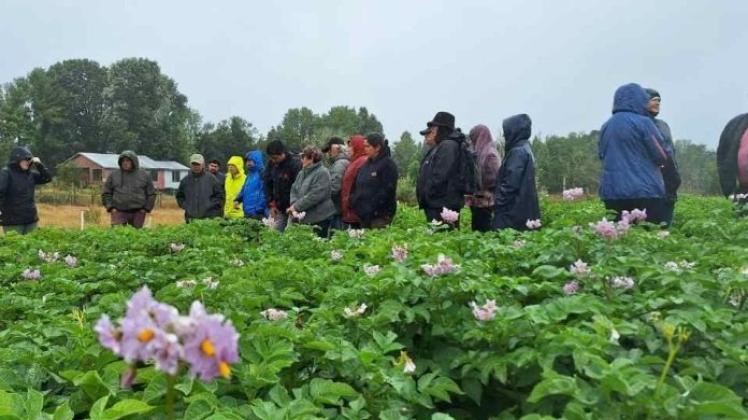
The two days organized by INIA in Butalcura and Punahuel, in the commune of Dalcahue, highlighted the institution’s commitment to safer and more sustainable agriculture.
These activities promoted the efficient use of pesticides, biopesticides and resistant varieties, within the framework of a high-level international scientific collaboration.
With a large turnout of farmers, technical advisors, and national and international experts, the Agricultural Research Institute (INIA) held these workshops in the province of Chiloé. Their main objective was to minimize the use of chemical pesticides in potato cultivation, a key crop for food security and the economy of the archipelago.
The activities took place in two locations: the INIA Butalcura Experimental Center and the Punahuel area, as part of a project funded by the UK’s Croda Foundation. This project, implemented by INIA nationwide, is carried out in collaboration with the International Center for Agriculture and Biosciences (CABI).
During these sessions, comparative trials in potato crops were presented, evaluating the performance of varieties susceptible and resistant to late blight, along with various control strategies that included both chemical products and biological alternatives. Participants were able to observe the results directly in the field, which strengthened their understanding of more effective agricultural practices.
Felipe Cárcamo Astorga, technical advisor for the PRODESAL Dalcahue program, praised these initiatives as essential for local farmers, noting that the vast majority produce potatoes, either for their own consumption or for sale. He emphasized the importance of access to specialized technical information for maintaining healthy crops and protecting people’s health. He also highlighted the exceptional nature of having specialists from different regions in Chiloé.
From a scientific perspective, Ivette Acuña, a researcher and phytopathologist at INIA Remehue, explained that efforts are focused on optimizing phytosanitary management. She commented that they are evaluating more efficient ways to use chemical products and possible alternatives to reduce their consumption, including biocontrol and late blight-resistant varieties. According to Acuña, Chiloé’s unique climate, which is conducive to this disease, presents a unique opportunity to develop combined strategies that reduce dependence on traditional pesticides.
A key aspect of the workshops was the proper handling and effectiveness of pesticide application, a topic addressed by Patricio Abarca, a researcher at INIA Rayentué. In his practical presentation, he explained how correct calibration and handling of equipment not only improves the effectiveness of treatments in potato crops, but also protects human health and reduces environmental damage.
From the UK, Steve Edgington, lead nematologist at CABI and expert in biopesticides, highlighted the project’s practical value. He noted that these activities not only connect research with on-the-ground farming practices but also foster direct dialogue between academics and producers. According to Edgington, the approach aims to design combined strategies capable of reducing reliance on chemical pesticides while planning for the next steps.
Jean Franco Castro, a researcher at INIA Quilamapu and head of the Microbial Genetic Resources Bank, explained that these workshops are an integral part of ongoing work in integrated pest management. The activities covered topics such as sprayer calibration and comparisons between chemical and biological products, as well as resistant varieties, to enable farmers to make more informed decisions.
Gabriel Peña, a researcher at INIA Butalcura and coordinator of the workshops, highlighted INIA’s institutional commitment. He noted that these initiatives aim to bring scientific and technical advancements to farmers in order to strengthen Chiloé’s productive sectors from a sustainable perspective.
Finally, Gloria Morán, technical advisor for the PDTI Quemchi, shared her experience working with nearly 70 farming families, primarily dedicated to potato cultivation. She emphasized how valuable it was to connect exemplary farmers with these training opportunities to strengthen their skills and knowledge.
Fuente: inia.cl