
USA: Study shows that indigenous potato cultivation in the Four Corners region has lasted for more than 10,000 years.
A recent study from the University of Utah has thrown a wrench into the agricultural history of the southwestern United States.
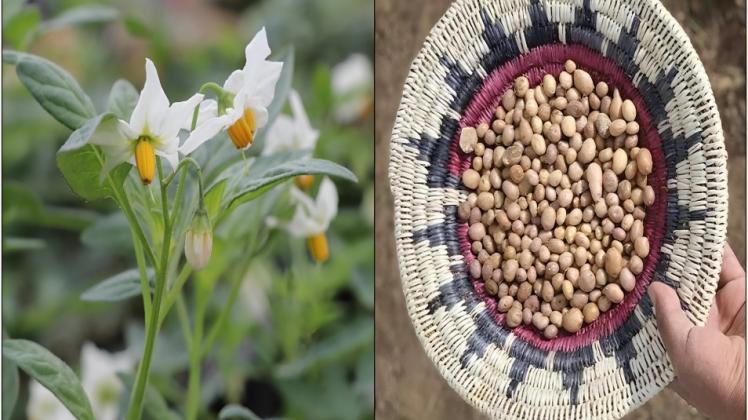
Starch residues preserved in ancient stone tools could rewrite the history of crop domestication in the southwestern United States, according to new research led by the University of Utah.
The Four Corners potato (Solanum jamesii) has been a staple food, cultural, nutritional, and medicinal resource on the Colorado Plateau for millennia. Despite its long history and contemporary use, the extent to which Indigenous peoples domesticated S. jamesii remains unknown. Previous genetic research has shown that the tubers were intentionally transported and cultivated far beyond their natural range—two crucial steps in demonstrating domestication.
In a new study , researchers analyzed hundreds of ground stone tools from dozens of archaeological sites located both within and outside the potato’s natural range. They looked for microscopic starch granules of S. jamesii in the crevices of ancient food-processing tools: large slabs (metates) and hand-grinding stones (manos). S. jamesii granules were found on tools from nine archaeological sites, four of which showed continuous use of the tuber dating back 10,000 years.
These findings, combined with independent evidence from nearly a decade of research, strongly support the idea that the initial stages of S. jamesii domestication by Indigenous peoples occurred in the Four Corners region of the United States. “By incorporating new archaeological data and ethnographic interviews, we are building a case for S. jamesii domestication in the American Southwest,” said Lisbeth Louderback , an anthropologist at the University of Utah and the Natural History Museum of Utah, and lead author of the study.
This study is the first to define the anthropogenic distribution area of S. jamesii, a product of extensive trade networks across the Colorado Plateau. Indigenous people transported plants from their natural range to establish new populations along a narrow strip in the Four Corners region, particularly in present-day Escalante, Bears Ears, and Mesa Verde.
“Traits in S. jamesii from the anthropogenic range already show evidence of manipulation, including population variations in freezing tolerance, prolonged tuber dormancy, and sprouting resilience, and we suspect there are others that can be identified in the genome,” said Bruce Pavlik, a plant ecologist at BMP Ecosciences, a museum-affiliated researcher, and co-author of the paper. “The next step in the project is to detect artificial selection, the definitive evidence of complete domestication.”
These cultivated plants established a unique cultural element around the potato, which endures to this day. Almost all the Diné (Navajo) elders interviewed for the study had a special knowledge of the tuber, which they called "nímasii yázhí," a term that referred to the person as the potato’s little relative. Hopi elders used the term "tumna." Remnants of vegetable gardens with living plants can still be found in those ancient gardens.
“The mobility of Indigenous food customs was driven by kinship-based practices across the landscape. Indigenous knowledge holders, especially matrilineal women, preserved these seeds and stories across generations to maintain ties to their ancestral lands and food customs,” said Cynthia Wilson (Diné), a doctoral candidate at the University of California, Berkeley, and co-author of the study.
Tubers, hands and metate
S. jamesii is a wild tuber native to the Mogollon Rim, a region encompassing south-central Arizona and the Mogollon Mountains of New Mexico. Here, S. jamesii plants are common throughout the landscape. Outside its natural range, populations tend to be small and are often found near archaeological sites.
Compared to red potatoes, Four Corners potatoes contain three times more protein, twice the calories and essential minerals, and significantly more dietary fiber. These nutritious snacks were highly valued, easy to transport, and provided a consistent diet. In 2024, DNA analysis of living plant populations revealed genetic corridors along which people transported and cultivated new populations.
Indigenous people prepared potatoes and other crops using their hands and metates. The grinding process releases starch granules from the plant tissues, which lodge deep within the cracks of the stone. Over the past decade, Louderback has perfected the method for extracting, isolating, and identifying these starch granules.
These metates came from Rooms 28 (left, item no. H/3293) and 54 (right, item no. H/5773) at Pueblo Bonito in Chaco Canyon and produced starch granules from S. jamesii. Credit: Anthropology Division, American Museum of Natural History.
His team sampled 401 metates and manos from 14 archaeological sites both within and outside the tuber’s natural range. More than half of the tools came from the archaeological collections of the Natural History Museum of Utah, and the rest were borrowed from various repositories across the country.
Tools with the highest proportion of S. jamesii starch granules come from the Four Corners region of southern Utah (North Creek Refuge), southwestern Colorado (Long House, Mesa Verde), and northwestern New Mexico (Pueblo Bonito, Chaco Canyon). These sites also support living plant populations nearby.
“The starch granules corroborate our earlier claim that the tubers were transported over long distances, but they also suggest that the species was used persistently for thousands of years within the region we describe as the ’anthropogenic range’,” Louderback said.
Agricultural legacy on the Colorado Plateau
The academic world has long rejected the idea that Indigenous peoples of the American Southwest domesticated native plants, arguing instead that local agriculture relied primarily on crops domesticated in Mesoamerica, such as maize, beans, and squash. Recent studies have challenged this paradigm by presenting evidence that people cultivated and influenced native plants, such as agave, barley, and amaranth. However, these studies are often insufficient compared to the robust documentation associated with plants from other regions of the world.
Over the past decade, the study’s research team has investigated multiple independent lines of evidence regarding the domestication of S. jamesii, including genetic, ecological, archaeological, biogeographical, ethnographic, and linguistic data. Indigenous peoples routinely traded plants throughout the region, altering local landscapes and leaving ecological legacies that persist to this day. In 2021, the research group found dense concentrations of culturally significant plants around archaeological sites , even when the species was absent from the surrounding environment. The Four Corners potato was one such species.
The study interviews revealed that Diné farmers and elders still know about, cultivate, and consume S. jamesii tubers, in addition to using them for spiritual purposes, such as water offerings and seedling planting ceremonies. A marked difference was observed in how the interviewees referred to the potato. The women used the present tense and knew how to process and eat it; all mentioned the use of glésh (a special white clay) to reduce its bitterness. The men spoke of the potato in the past tense and did not have specific knowledge about its preparation. The interviewees detailed how they use other wild plants and domesticated crops. All spoke of contemporary struggles, such as access problems, that hinder their ability to continue traditional land-use practices and food systems.
“Involving the voices of indigenous farmers and gatherers in land use practices is essential to preserving the health of the indigenous land and people by keeping access to small tubers for traditional and intact populations,” Wilson said.
Other authors include Stefania Wilks, Kaley Joyce, and Sara Rickett of the University of Utah and the Natural History Museum of Utah; John Bamberg of the United States Potato Gene Bank (USDA/ARS); and Alfonso del Río of the University of Wisconsin-Madison.
Based on the study, “ Ancient use and long-distance transport of the Four Corners potato (Solanum jamesii) across the Colorado Plateau: implications for early stages of domestication,” published in PLOS ONE on January 21, 2026.
Some of the polished stone tools analyzed in this study come from the first archaeological expeditions to Chaco Canyon in the early 20th century. Pueblo Bonito, the largest main house in Chaco Canyon, contains hundreds of rooms filled with a wide variety of cultural materials, including vessels, jars, manos, and metates, as well as rare and exotic objects that reflect the region’s extensive trade networks. Room 28 (left, item no. 41181) housed cylindrical jars with preserved cacao residue, brightly colored macaw feathers, and pieces of turquoise, all imported from Mexico. In this same room, one of the metates contained starch residue from the Four Corners potato. Room 54 (right, item no. 411960) is another space in Pueblo Bonito that contained three metates with preserved S. jamesii starch residue. In total, 18 rooms within the main house contained manos and/or metates containing starch from S. jamesii. Credit: Courtesy of the Anthropology Division, American Museum of Natural History.
Fuente: attheu.utah.edu/


