Argentina (Río Negro): He was a greengrocer in Córdoba and today he invests US$50 million in potatoes and other crops to transform the Patagonian dese
Pablo Ríos knows nothing of impossibilities and in Río Negro he will do something he already knows: transform aridity into a garden through irrigation, with gas as a strategic ally.
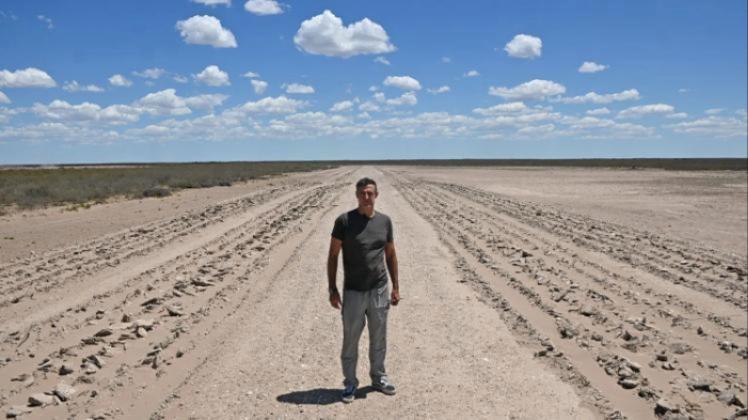
At 14, Pablo Ríos opened a greengrocer’s in the city of Córdoba, never imagining that three decades later he would be leading one of the most ambitious agricultural investments in northern Patagonia. Today, at the foot of National Route 250, between General Conesa and Guardia Mitre , he is spearheading the development of a 2,800-hectare farm in the heart of the Patagonian desert, 2,300 of which will be irrigated, with unprecedented infrastructure in the region and a clear objective: to produce alfalfa for export, large-scale livestock farming, and its own energy source based on natural gas.
The project, which will require a total investment of US$50,000,000, combines high-tech pressurized irrigation, pumping from the Negro River, a gas-fired power plant, and an integrated approach to production, logistics, and foreign trade. “Drip irrigation, a port, and gas. That’s the project’s three pillars,” summarizes Ríos, who anticipates completing the development in 2027 and launching an alfalfa mega-bale compacting plant in General Conesa.
From greengrocer in Cordoba to closing the entire chain
Pablo Ríos’s dedication and passion for his work were evident during his interview with Río Negro Rural, and there’s reason to believe it’s something that has characterized him throughout his life. "I’m from Córdoba, and I got involved very young, at 14, I started with a fruit and vegetable stand. I don’t come from a family with an agricultural tradition, but I do have a commercial one," Pablo recounts. That first retail experience was the starting point for sustained growth: from a neighborhood stand he moved to a distribution company and, shortly after, to exporting produce.
The big break came after the 2001 crisis, thanks to an uncle who farmed horticulture in southern Buenos Aires. “In 2003-2004, we had the opportunity to export. Argentina was very cheap to export,” he says. The first product was onions, with Brazil as the initial destination. In just a few years, growth was exponential: from 11 truckloads exported in the first year to more than 200 in the third, with their own warehouse and agreements with Brazilian supermarket chains.
See moreCentral Market PricesPackaging materialsPotato marketProduct marketMembership in agricultural associationsAgricultural classifiedsPrice variationAgricultural management softwarePope NewsStorage equipmentThis expansion revealed a key limitation: the quality and predictability of the raw materials. “We started producing because we wanted high-quality products, which the producers weren’t offering. Sometimes prices went up, and they didn’t honor the contracts,” he explains. In 2010, he took the decisive step toward his own horticultural production, incorporating pressurized irrigation and, later, drip irrigation, when it was still in its infancy in the region under the auspices of the Colorado River Development Corporation (Corfo).
The model, based on onions, garlic, and potatoes, was consolidated with a strong technological focus: full mechanization, optical sorting, automated sheds, and leadership in drip irrigation acreage. “We were the first in the area with drip irrigation. Today we produce between 200 and 300 hectares with that system and we are the largest using it,” he states. The journey included production experiences in the Corfo area, La Pampa , and Carmen de Patagones , always with the aim of integrating production, packing, and export. Water, energy, logistics, and labor availability were some of the challenges Ríos faced along the way.
Río Negro, gas and an unprecedented project in the Patagonian desert
Proarco Patagonia SA’s current venture in Río Negro (the company chaired by Pablo Ríos) is a culmination of everything they’ve learned. “I chose to leave Patagones because there isn’t energy available there in the location and quantity we need. Here, gas flows through, and we define gas as energy; we won’t deviate from that energy source,” he explains. This has been the key to Ríos’s decision, as it represents a significant leap in efficiency.
The infrastructure at the chosen site is limited, so the project was designed to be self-sufficient: it will draw water from the Negro River by pumping, convey it through a first canal in the valley, and then pump it again to direct it through four large pipes to a second canal on the plateau, across Route 250. Construction of the pumping station has already begun. Along both canals, which have already been laid out and leveled, the water will be distributed by gravity.
The second canal, between 8 and 9 kilometers long, will have several pumping stations and will serve as the main irrigation distribution hub for 2,300 hectares irrigated with a combination of center pivots and subsurface drip irrigation. “The pivot system plays a role in germination, and then the crop develops with drip irrigation, which uses less water and produces much more,” he explains. The key to energy efficiency lies in on-site generation: gas-powered engines fed from the main Conesa-Viedma gas pipeline will drastically reduce irrigation costs.
See moreFight against smugglingWeather stationsVarieties of papaCentral Market PricesClimate for agricultureCentral MarketAgronomic consultingtablePotatoClimate forecasting tools“The unique aspect of this project is that the energy will be generated with gas. There’s no electricity, and building a 50-kilometer power line was unfeasible,” he points out. The direct purchase of gas from producers, taking advantage of the lower summer consumption, is another differentiating factor. “Our consumption will be similar to that of Viedma in a year, but almost all of it will be in the summer, when gas isn’t used,” he explains.
The project also presents a major logistical challenge: the port of San Antonio Este. “It’s crucial that it has sufficient volume to make alfalfa exports viable and to consolidate a hub,” argues Ríos, convinced that productive development must be accompanied by public and private initiatives to revitalize the port terminal. With this collaboration, he explains, Río Negro would offer a competitive advantage that could become a decisive differentiator compared to other producing regions.
Investment in alfalfa and livestock in Río Negro
The choice of crop is not accidental. “Our DNA is exporting,” says Ríos, who sees alfalfa as a crop with price stability, excellent yields and quality in Río Negro, and less climate risk than horticulture. Water efficiency is crucial where aridity reigns, and that’s why he’s betting on something uncommon in alfalfa: “With drip irrigation (and fertigation), we use three times less water than with a conventional irrigation system, and productivity skyrockets.”
Livestock farming completes the picture, with a focus on scale and risk management. The goal is to develop an integrated system for breeding, raising, and finishing, supported by on-farm forage production and ruling out dryland farming as an option. “For a large feedlot to work, you need to guarantee a steady supply of animals. Otherwise, you end up paying inflated prices and buying animals without the desired genetics,” he explains. The strategy focuses on semi-confined breeding cows, raising cattle on alfalfa, and finishing them in feedlots, always with volume and predictability.
In the first year, each plot will start with horticultural crops and corn to allow them to stabilize and to prepare the soil before installing the subsurface drip irrigation system. “Between July and October, which is potato planting season, we will have between 800 and 1,000 hectares irrigated and in production. Next year we will complete the process, reaching 2,300 hectares,” explains the president of Proarco Patagonia SA. A large portion of that area has already been cleared.
The crop rotation will then focus on alfalfa and cattle feed. The project will culminate in the alfalfa mega-bale recompaction plant in General Conesa, scheduled for completion in 2027, which will add value and reduce logistics costs.
“We’re talking about a total investment of 50 million dollars,” Ríos explains. This figure summarizes the journey of someone who started selling vegetables in a neighborhood in Córdoba and today is committed to transforming the Patagonian desert into an export platform, with gas, water, and technology as the pillars of a long-term productive vision.
Fuente: Río Negro